6 mins
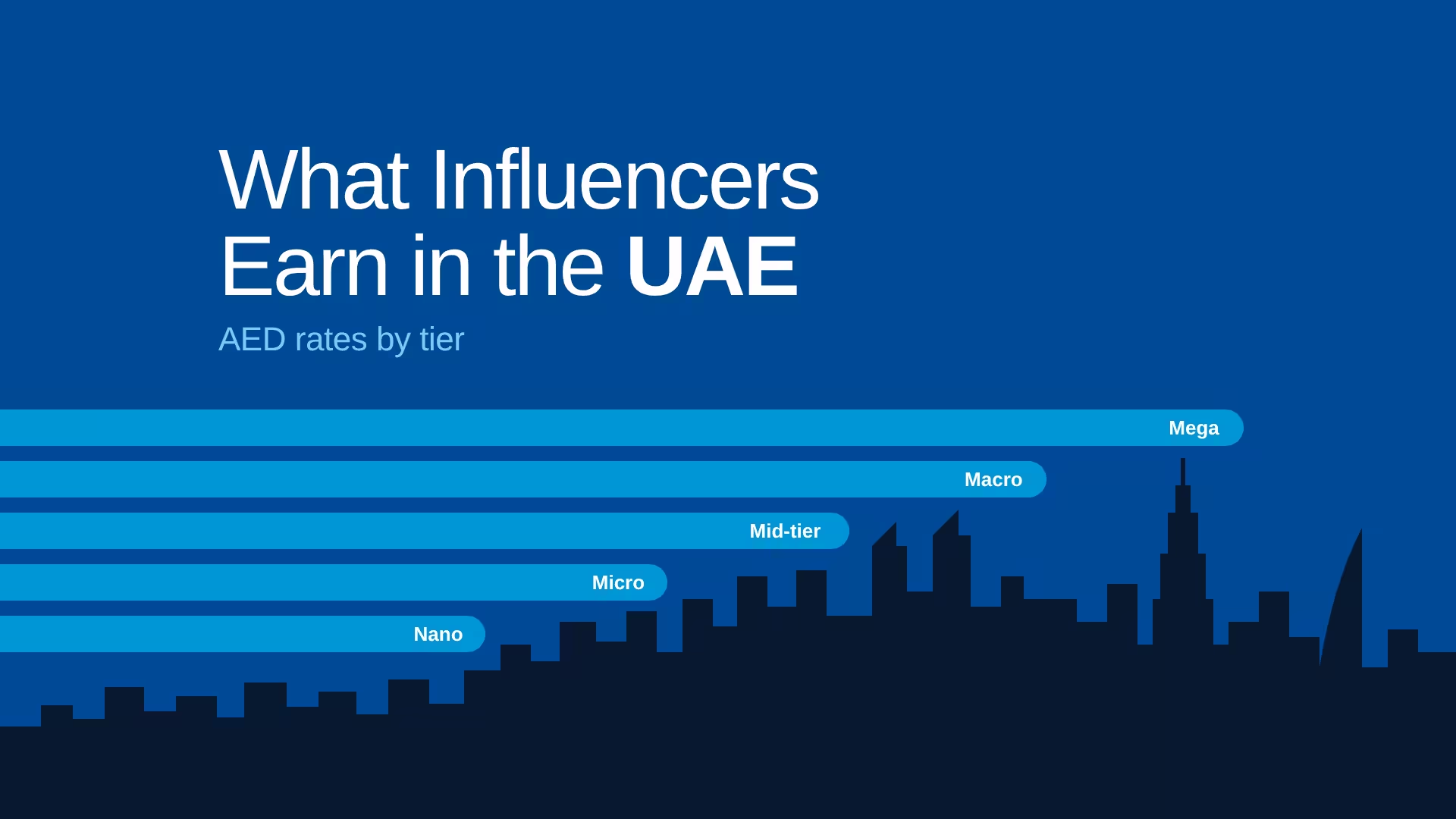
What influencers earn in the UAE is typically AED 500 to AED 2,500 per sponsored post, based on a 2026 review of 350 signed contracts. Medians are AED 500 for nano, AED 1,000 for micro and AED 2,500 for macro creators. Published rate cards quote far higher fees. Mega creators sit around AED 10,000.
What UAE influencers earn: key takeaways
- Signed 2026 contracts show medians of AED 500 (nano), AED 1,000 (micro), AED 2,000 (mid), AED 2,500 (macro) and AED 10,000 (mega) per post.
- From the mid tier up, published rate cards start above the highest fee in that contract sample.
- The average Dubai influencer salary on Indeed is AED 5,107 a month, so a micro creator needs about five paid posts a month to match it.
- Usage rights add 20% to 50% to a base fee and exclusivity adds 15% to 30%, according to Boomerang's rate guidance.
- Since 1 February 2026, posting promotions from inside the UAE needs an Advertiser Permit, and posting without a licence starts at an AED 10,000 fine.
How much do influencers earn per post in the UAE?
Per-post fees rise with follower count, but far less steeply than published rates suggest. The table sets a 2026 rate card from a UAE talent platform beside what one Dubai agency recorded in 350 signed influencer contracts between August 2025 and August 2026. Tier cut-offs follow that contract report. Boomerang's own tier definitions are in our guide to micro vs macro influencers.
published rate card from a UAE talent platform's 2026 brand-collaboration guide; contract figures from a Dubai agency's 2026 influencer rate report (350 contracts, August 2025 to August 2026)
Two cautions apply to the contract columns. They come from one agency's files, and half of that agency's client folders were left out for incomplete paperwork. The macro and mega samples are also small, at 30 and 10 contracts. The figures record cash fees. Some deals add hotel stays or products on top, so they understate total value in hospitality and luxury. Read the medians as a reference point for agency-run campaigns, not a promise.
Why do published rates run higher than signed contracts?
A rate card is an opening quote. A contract records what the brand bought. The agency report behind the table found that moving from 20K to 250K followers lifted the creator fee only from AED 1,000 to AED 2,500, a 2.5x rise, while rate cards imply roughly ten times. In that sample, price followed the shape of the deal more than the size of the account.
A 2019 survey by Bukhash Brothers, reported by Gulf News, shows the gap is not new. Most UAE micro-influencers in that survey said they charged USD 1,000 to 2,500 per sponsored post, about AED 3,700 to 9,200. That is well above today's signed micro median of AED 1,000. Stated prices and paid prices have rarely matched.
For creators, both mistakes are common: quoting a card the market does not pay, and accepting a flat fee that leaves out paid usage. For brands, a quote far above these medians is a prompt to ask what the fee includes.
How much do Instagram influencers make in the UAE?
On Instagram, the format moves the fee more than anything else. Boomerang's UAE rate card prices a story set below a static post, a static post below a Reel, and a monthly ambassadorship above all three.
Brands comparing these ranges with agency packages can see how Boomerang structures campaign budgets on the influencer marketing pricing page.
TikTok numbers are harder to pin down. One Gulf News feature quoted TikTok fees from AED 700 to AED 70,000 per post, and gave two different creator-fund payouts per 1,000 views in separate sections, without naming a source for either. A range that wide cannot guide a decision, so this guide leaves TikTok out of the tier figures.
Do Instagram influencers get paid in the UAE?
Yes. UAE Instagram creators are paid cash fees per post, Reel or story set, and many also take products or experiences. In the Bukhash Brothers survey, over 80% of respondents said they would barter for free products, services or experiences, and 24% said influencing was their main source of income. Smaller creators are more often paid in product, while macro and mega creators usually ask for cash, as Boomerang's influencer rates guide for brands sets out.
How do influencers get paid in the UAE?
UAE creators are paid in four ways, often mixed within one campaign:
- A flat fee per deliverable, agreed before posting.
- A monthly retainer or ambassadorship, which on Boomerang's rate card runs from AED 3,000 to AED 12,000.
- A commission on sales through a code or link.
- Products, meals, stays or experiences instead of, or on top of, cash.
The terms that decide when and how a creator is paid, including payment dates and cancellation, belong in a written agreement. Our UAE influencer contracts guide covers what to include.
What pushes a fee above the base rate?
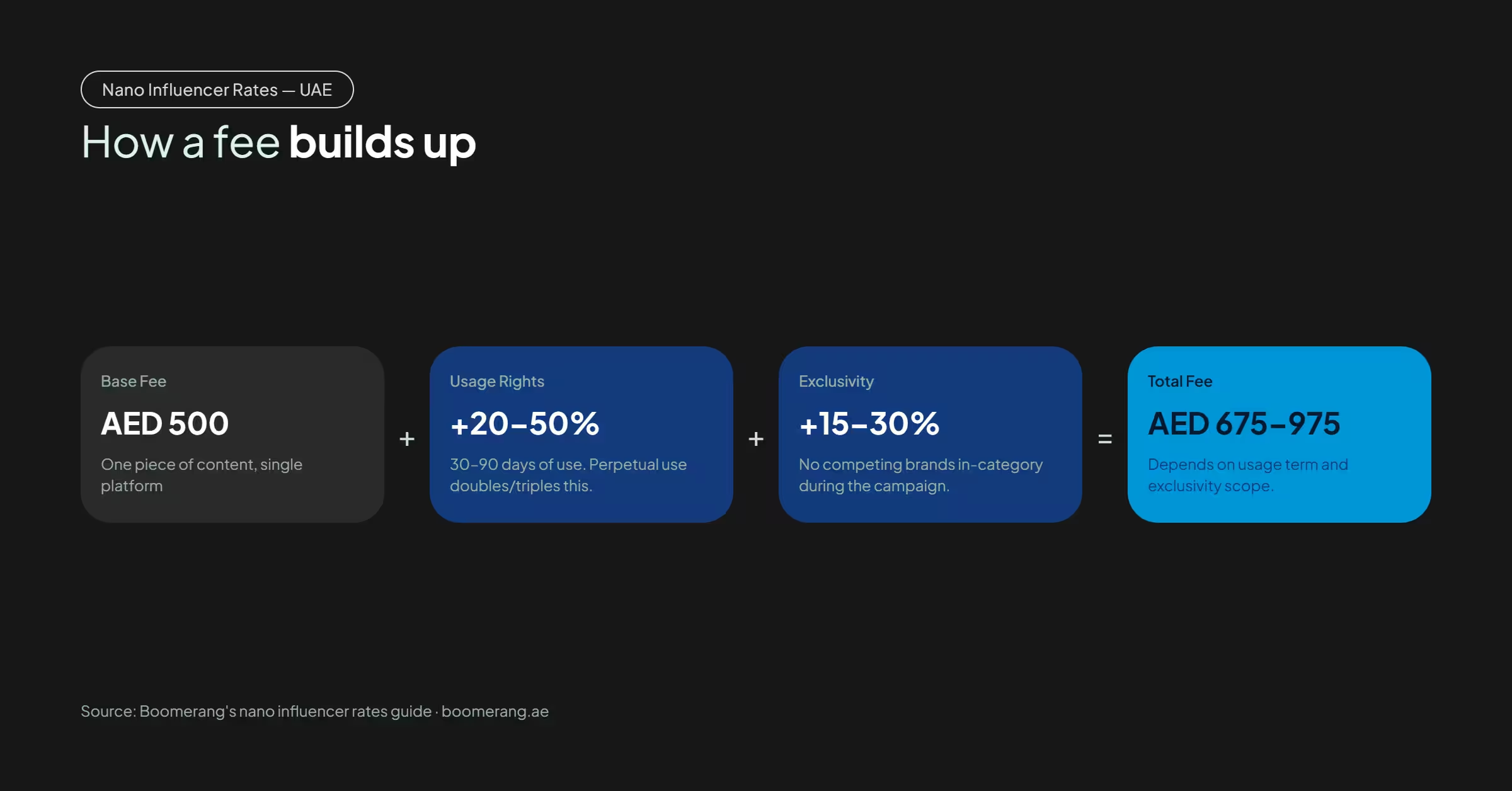
Usage rights and exclusivity do. According to Boomerang's nano influencer rates guide, standard usage rights of 30 to 90 days add 20% to 50% to the base rate, full or perpetual usage can double or triple the initial fee, and an exclusivity clause adds 15% to 30%. A creator who agrees to a flat fee and then sees the brand run the video as a paid ad for a year has been underpaid.
Industry matters less than most people expect. In the contract report, most industries paid within a band of AED 700 to 1,500 per creator. Fintech and banking ran higher, at AED 1,000 to 5,000, and luxury hospitality paid AED 1,700 to 2,600 against AED 700 to 800 for standard hotels. The bigger difference was what brands added on top of the payment.
IMAGE 2, insert here. File: influencer-fee-structure-usage-rights-exclusivity-uae.webp. Alt text: Diagram of how an influencer fee in the UAE is built from base fee, usage rights and exclusivity. Caption: Usage rights and exclusivity add to the base fee.
Is influencing a full-time income in the UAE?
For some creators it is, for many it is not. Indeed's salary data lists an average of AED 5,107 a month for influencers in Dubai, from 47 reported salaries, with the middle 80% of reports falling between AED 2,146 and AED 12,153. Those are self-reported and the sample is small, so treat them as a rough benchmark.
The table turns the signed-contract medians into a monthly picture. The number of paid posts per month is an assumption made for illustration, not a measured figure.
A micro creator who books four paid posts a month grosses AED 4,000, just under the Dubai average, and passes it at a fifth post. Mid and macro creators clear it in this model, but only while bookings keep coming. These are gross figures. Licence and permit fees, equipment, production time, and any VAT or corporate tax that applies to the business structure all come out of them, so confirm the tax position with a UAE accountant.
Do bloggers make money, and how much do bloggers earn?
Some do, and the spread is wide. Global income surveys show that most bloggers earn little and a small share earn a lot. A ProBlogger survey found that 26% of bloggers earned under USD 10 a month and nearly half earned under USD 100, while 4% of those trying to make money from blogging made over USD 10,000 a month. Blog owners commonly report USD 200 to 2,500 a month in their first year, and sponsored posts on blogs average roughly USD 25 to 750.
These are mostly US-based figures, and no reliable UAE blogger income survey exists. Bloggers make money the same ways other creators do: advertising, sponsored posts, affiliate links and their own products. In the UAE the sponsored route follows the influencer rates above, and the Advertiser Permit applies to blogs and websites as well as social media.
How do travel bloggers make money?
Travel and food creators are often paid partly in stays, meals and experiences, which is why cash fees alone understate what they receive. The contract report shows luxury hospitality deals commonly combine a payment with a package. The earning methods are the same as in the sections above.
Who are the highest paid Instagram influencers?
Global rich lists put the top names at seven figures per post. A 2018 Hopper HQ list, reported by Gulf News, had Kylie Jenner at USD 1 million per post. The UAE market looks different. The highest fee in the signed-contract sample is AED 20,000, and Boomerang's planning range for mega creators reaches AED 250,000 or more per post.
No reliable public ranking of UAE creator earnings exists. Lists that attach exact figures to named individuals rarely come from contracts, so treat them with caution.
What UAE rules affect how much an influencer keeps?
Since 1 February 2026, anyone who creates or publishes promotions from inside the UAE needs an Advertiser Permit from the UAE Media Council, whether the content is paid or unpaid and whether it sits on social media, a website or a blog. Gulf News reports that operating without a licence carries a fine of AED 10,000 for a first offence and AED 40,000 for a repeat, and that content breaches range from AED 5,000 to AED 1 million depending on severity.
Published guidance says the permit itself carries no fee for UAE citizens and residents for the first three years. A trade or freelance licence costs extra and varies by free zone and activity, so check current fees before you set a price. Companies can only contract licensed creators, so a missing permit costs bookings as well as risking fines. Our guide to the influencer licence in Dubai walks through the steps.
How can you start earning as an influencer in the UAE?
Pick one niche, build an engaged audience on one main platform, get licensed and permitted, then pitch brands or sign with an agency. The step-by-step version is in our guide on how to become an influencer in Dubai. Creators who want representation can look at Boomerang's talent management service.
FAQ: what influencers earn in the UAE
How much do influencers earn in the UAE?
Signed 2026 contracts show median fees of AED 500 per post for nano creators, AED 1,000 for micro, AED 2,000 for mid, AED 2,500 for macro and AED 10,000 for mega. Published rate cards quote much higher figures. Monthly income depends on how many paid posts a creator books, plus any retainers or commission.
Do Instagram influencers get paid in the UAE?
Yes. Brands pay UAE Instagram creators cash fees per post, Reel or story set, gift products or experiences, or sign monthly retainers. Boomerang's UAE rate card puts a Reel at AED 1,000 to 3,500 and a story set at AED 300 to 800. Smaller creators are more often paid in product.
How do influencers get paid?
Through a flat fee per deliverable, a monthly retainer, a commission on sales through a code or link, or free products and experiences. Fees rise when a brand wants paid usage or exclusivity. In the UAE, creators also need a valid Advertiser Permit before companies can contract them.
How much can a micro-influencer make in a month?
At the AED 1,000 median for micro creators, four paid posts gross AED 4,000 a month and five gross AED 5,000, close to the AED 5,107 average Dubai influencer salary on Indeed. These are gross figures before licence fees, equipment and any tax, and they assume bookings continue every month.
Do I need a licence to earn money as an influencer in the UAE?
Yes. Since 1 February 2026, anyone publishing promotions from inside the UAE needs an Advertiser Permit, paid or unpaid, and most creators also need a trade or freelance licence. Operating without a licence carries a fine of AED 10,000 for a first offence and AED 40,000 for a repeat.
Do bloggers make money, and how much do bloggers earn?
Some do, but most earn little. Global surveys found nearly half of bloggers earn under USD 100 a month, while a small share makes more than USD 10,000. There is no reliable UAE blogger income survey, so use the influencer rates above as the guide for sponsored work.
What this means for creators and brands
Creators should price from signed contracts, treat a rate card as an opening position, and charge extra for usage rights and exclusivity. Brands should budget for scope, because the length of usage and the exclusivity clause move a fee more than follower count does.
If you are planning a campaign, Boomerang's influencer marketing services in Dubai cover creator selection, contracts and reporting across the UAE and GCC. To talk through rates for your brand or your channel, contact the Boomerang team.